
Manassas Previous Residents Sources
One Manassas address can be traced through several eras, but the records do not overlap perfectly. Eagle Recorder carries the online deed trail from 1918. RELIC holds the earlier county indexes, local telephone and city directories, newspapers, maps, and microfilm. Census schedules place a household at an enumeration date. Plans and permits can date a change to the structure. Use the current parcel identifiers as the thread through every source, particularly when the address wording changes.
| Source | Years It Covers | Where Held | What It Shows |
|---|---|---|---|
| Eagle Recorder deeds | Jan. 1, 1918 to present | Circuit Clerk and online index | Recorded parties, dates, legal description, instruments, and images |
| RELIC deed index | 1731 to 1827 | RELIC Digital Archives | Early Prince William County deed index |
| Manassas directories | 1960 to 1983; 2001 | RELIC | Listed household and address in each edition |
| Local telephone directories | 1903, 1931, 1941, 1951; 1958 to 2009 with gaps | RELIC | Subscriber and address leads |
| Federal census | 1790 to 1950 releases | NARA, RELIC, and library sources | Household and place on the enumeration date |
| Plans and permits | Historical online run not stated | City GIS and Community Development | Plan metadata, work history, and address or parcel link |
Start at the present and move backward. A known transfer after 1918 belongs in Eagle Recorder. An address that predates that online cutoff needs RELIC, Clerk materials, Library of Virginia microfilm, or FamilySearch as the next route.
Manassas Parcel Snapshot First
Before looking for past residents, preserve the current Manassas parcel facts: full address, tax-map number, legal description, last-sale date and price where populated, and the date the assessment or map was viewed. City assessment owner information is refreshed monthly, and land-book information reflects a different cycle. The GIS parcel service can expose FULL_ADDRESS, TAXMAP_NUM, LEGAL_DESC, valuation fields, and last-sale data, but not a complete owner or mailing-address field. City GIS is reference data, while the Circuit Clerk controls deeds and plats.
A mailing address should be written down as a mailing field, not silently treated as the former resident’s location. It can identify a trust, an estate, an agent, a business, or a post-office box.
Manassas 1918 Deed Break
The online cutoff is a practical turning point for previous residents research. Eagle Recorder places deeds and related land records online from January 1, 1918. Earlier ownership did not begin in 1918, it simply needs another channel. Clerk public terminals and deed books, Library of Virginia locality microfilm, RELIC Digital Archives, and the FamilySearch Virginia Wills and Deeds collection become the fallback chain. RELIC’s Prince William Deeds Index reaches 1731 to 1827 and can help form the next book or microfilm question.
The Virginia Secure Remote Access land-records page explains why image access varies by clerk authorization and why a free index does not always mean free remote images.
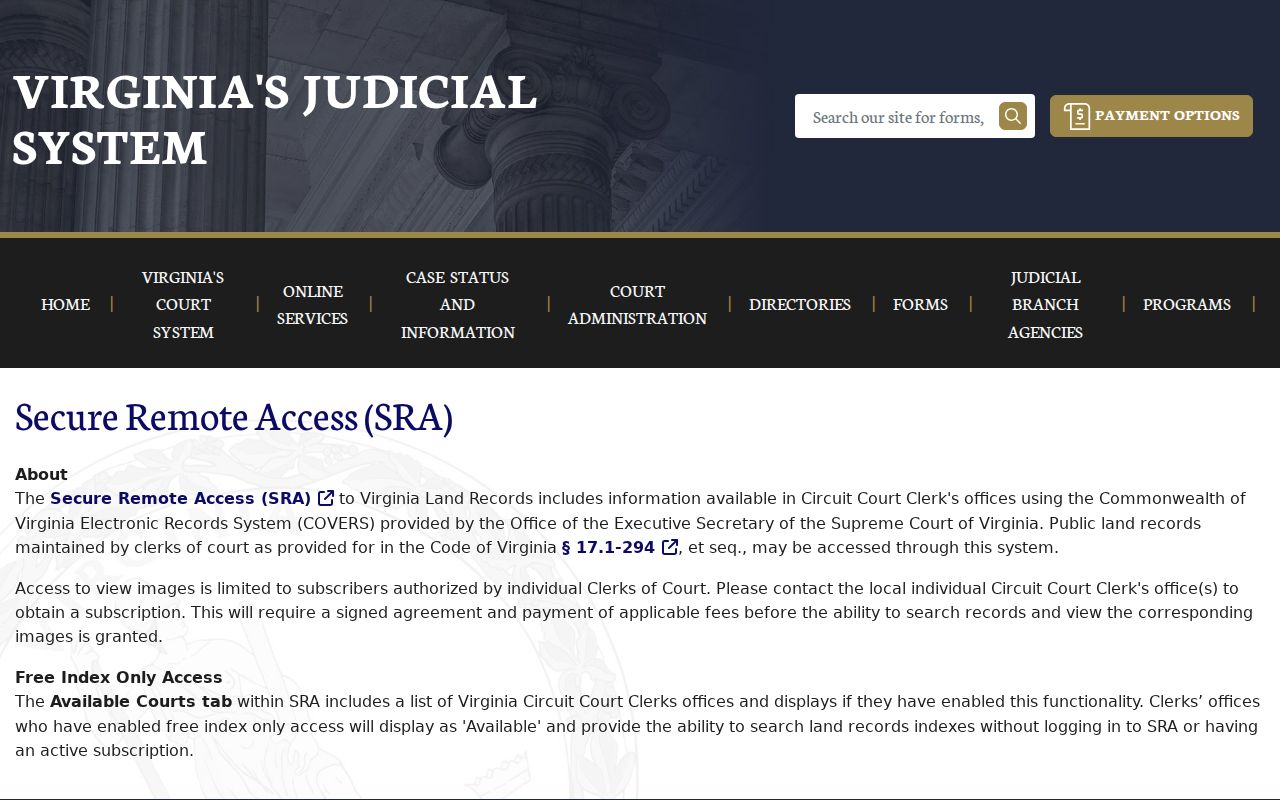
At the cutoff, move to the Clerk or historical collection with the legal description, not a guess about a modern street-number conversion.
Manassas Property Alert Clue
The Circuit Clerk’s free Property Alert System launched on April 23, 2025 for Prince William County, Manassas, and Manassas Park. It sends a notice when a document associated with a parcel ID or owner name, such as a deed, mortgage, or mortgage satisfaction, is recorded. That is useful for monitoring a known address going forward. It does not replace the historical grantor-grantee search or stop an instrument from being recorded. Check every alert against the official index and preserve the instrument number for follow-up.
The Prince William Property Alert System is the direct clerk route.
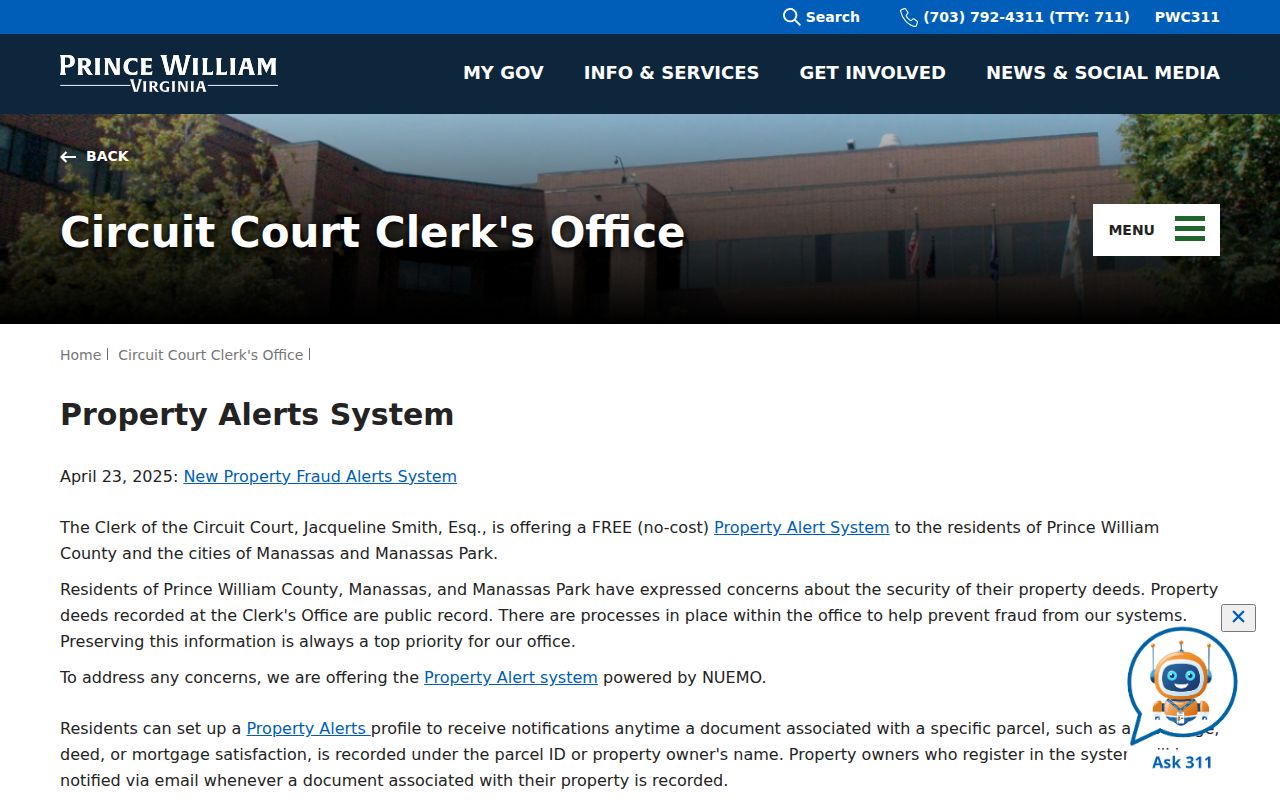
For a past transfer, the recorded document and its legal description remain the evidence to compare against the parcel.
Tracing Manassas Previous Owners
A title trail moves backward by roles. Find the current owner as grantee near the property’s last-sale date. Confirm the result with its legal description, then record the grantor, instrument number or book and page, recording date, consideration where present, and marginal or related-document links. The grantor becomes the person to search as a grantee in earlier years. An estate, trust, company, or multiple-party transfer needs the same legal-description check before it is added to the chain.
- Record the current assessment address, tax-map number, legal description, and last-sale clue.
- Use Eagle Recorder Name/Legal Search for the current owner as first or second party, with a broad recording-date window.
- Open Detail Data or the image when available and confirm the legal description, not merely the street address.
- Search the confirmed seller as a grantee in earlier records, repeating the parcel comparison at each transfer.
- When the online result stops before 1918, move to the Clerk, RELIC, Library of Virginia microfilm, or the early county index with the same identifiers.
- Grantor / grantee
- The grantor transfers an interest; the grantee receives it in that recorded instrument.
- Chain of title
- The linked sequence of recorded transfers for the same parcel.
- Legal description
- The lot, block, subdivision, metes-and-bounds, or parcel wording used to identify land beyond a street label.
Manassas Directory and Census Pairing
Deeds identify a recorded transfer, while directories and census schedules can describe a household at a date. Use a directory edition near the target year, copy the listed name and address exactly, and look in its criss-cross section when available. Then compare it with the nearest federal census release, taking care with city and county boundaries and enumeration-district changes. RELIC has Virginia census microfilm for 1790 through 1930 and guides for local research; later federal releases follow the 72-year cycle. A directory absence can mean a move, an omission, or a gap in the run, not a definite departure.
- Choose the closest available Manassas telephone or city directory year.
- Copy the name, address, and edition-specific abbreviation key before interpreting any notation.
- Check the reverse section to test the address within that same volume.
- Compare the closest census year and its geography, then return to the deed trail for any ownership transition.
The Library of Virginia localities microfilm guide identifies the Manassas and Manassas Park locality route.
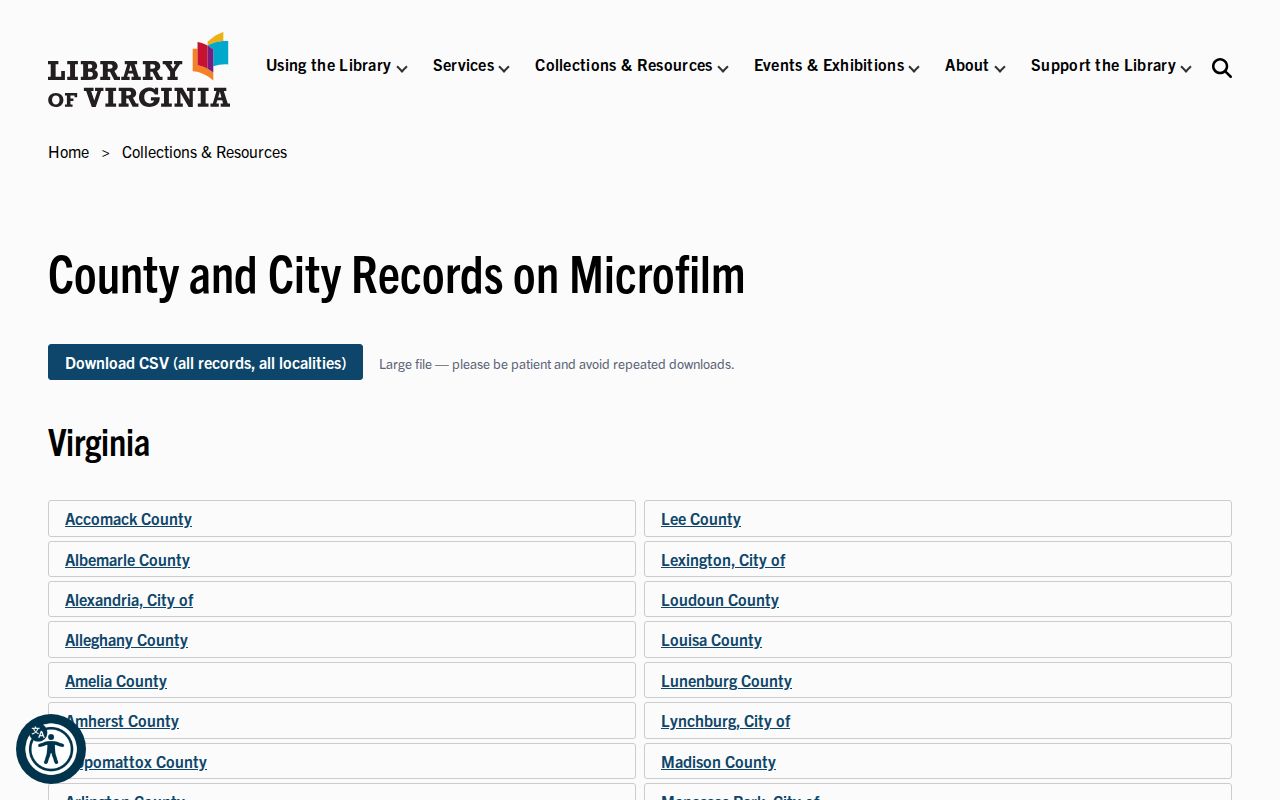
The library route is especially useful when the online land index has reached its published cutoff.
Manassas Address Change Checks
Do not invent a citywide renumbering date for Manassas. The research found no primary source for one. Instead, bridge an old address with the GIS centerline’s legacy street-name fields, left and right address ranges, historic maps, cross streets, lot and block language, the legal description, and the tax map. A 1912 Manassas Sanborn image is a useful structure and footprint clue, but it does not name residents. The Library of Congress collection is organized by state, city, and edition date, and an edition must be checked for actual digital availability.
City scan-plan metadata can provide plan name, ID, year, sheets, associated parcels, and addresses without relying only on map imagery. Ask Community Development for focused historic permit or plan material when the available online search fields do not expose it.
Manassas Estate Trail Endpoints
An obituary, funeral entry, probate file, or cemetery record may close a previous-residents trail or point to the next deed party. RELIC Digital Archives includes Manassas Democrat death reports from December 1909 through March 1921, Manassas Journal death notices for 1911 through 1915, and Baker Funeral Home Records for 1931 through 1969. Historic Prince William also publishes local obituary and clerk-paper finding aids. These are leads to compare with an original deed, probate file, cemetery source, or court record, not a reason to infer an address or relationship that the source does not state.
The Historic Prince William publications list shows the locally compiled indexes available for a deeper records question.
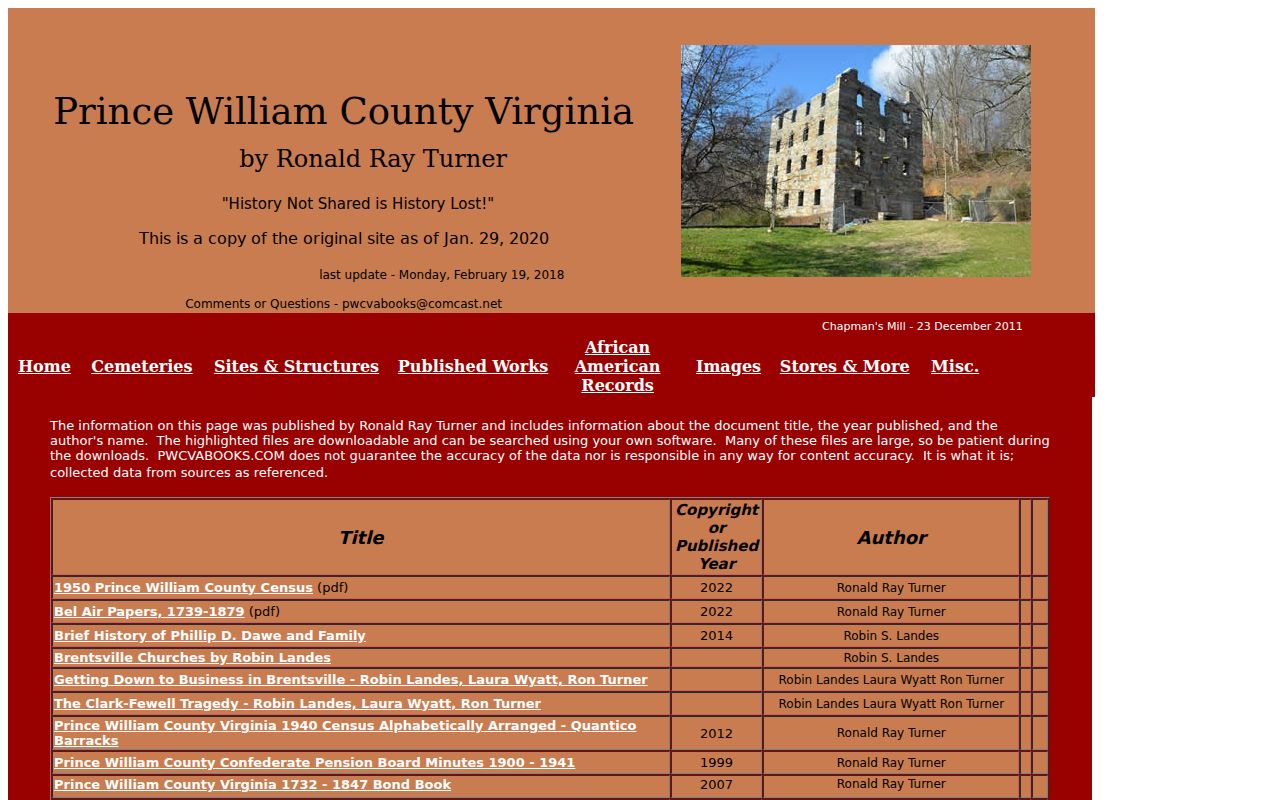
When a deed names an estate or personal representative, use the Circuit Clerk’s probate route to ask for the correct case or record rather than assuming an heir from a summary.
Manassas Past Household Evidence
Recorded owners are only one part of the past-household picture. A historical directory may list a subscriber or household at an address; a census may list people at its own enumeration date; a death notice can give family or funeral details; and probate can identify a representative or estate connection. Each source has omissions and time limits. The complete shelves and how to read a directory entry belong in the Manassas city directories collection, while this address trail keeps the focus on matching each item to the same parcel.
RELIC offers trained staff, local research guides, and Tree Doctor appointments for family-history questions. It is a practical fallback after the web index ends, especially when old county records use Manassas, Prince William, or postal wording differently.
Lawful personal research. Use Manassas previous-residents records for house history, family history, estate questions, or civic curiosity. Do not use a historic trail to stalk, harass, or harm a living person.